SEPT 25 - 27, 2026 | LONDON

The Golden Gate Bridge had disappeared.
On the Wednesday evening of Laver Cup 2025, the location chosen for one of the event’s most anticipated traditions was hidden beneath a blanket of San Francisco fog. As the photography and media teams watched the weather apps update, the window for the iconic team photo appeared to be closing.
A backup location was discussed. Instead, Laver Cup trusted the original vision. The decision produced one of the most striking images of Laver Cup’s nine-year history.
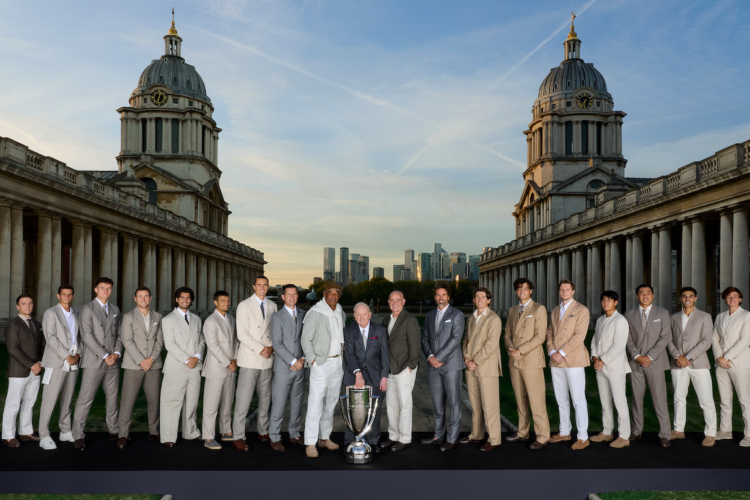
Since its debut at the inaugural Laver Cup in Prague in 2017, the team photo has become one of the defining images of the event.
Clive Brunskill, sports photographer at Getty Images, has orchestrated every edition of the team photo. “It is far from basic,” he says. From organizing a dozen superstar players in exacting positions to lining up lighting—sun and artificial—to managing the timing and location, taking the iconic photo is a process months in the making.
Emily Wright, head of public relations and media at Laver Cup, says the photo has so many more layers than placing athletes in front of a famous landmark. “The location has to tell the story of the host city, but it ultimately has to work from a photograph and operational perspective,” she says. “Every detail from the backdrop to security to transportation of the players to what the photographer feels comes into play to create an image that is timeless. We want it to stand the test of time.”
Originally, the photo was intended to create a memorable image of rivals becoming teammates. Now it has become part of the event itself, and each player receives a limited-edition print signed by all.
“The key is finding somewhere that says the city and is safe, and we can efficiently bring the players in and out,” Wright says. Everyone wants the same outcome. For Brunskill, he’s working out lighting angles, a clean backdrop and how to space the players; Wright spends time on building an arrival window where players have a seamless and enjoyable experience.
“People don’t understand the complexity,” she says. “The 20-minute shoot is one of the more precisely choreographed moments of players, captains, security and media. It is challenging and really rewarding.”
Wright and Brunskill were unanimous in choosing Berlin’s Brandenburg Gate as the pinnacle in terms of everything coming together for the “beauty shot” in 2024. San Francisco was a close second.
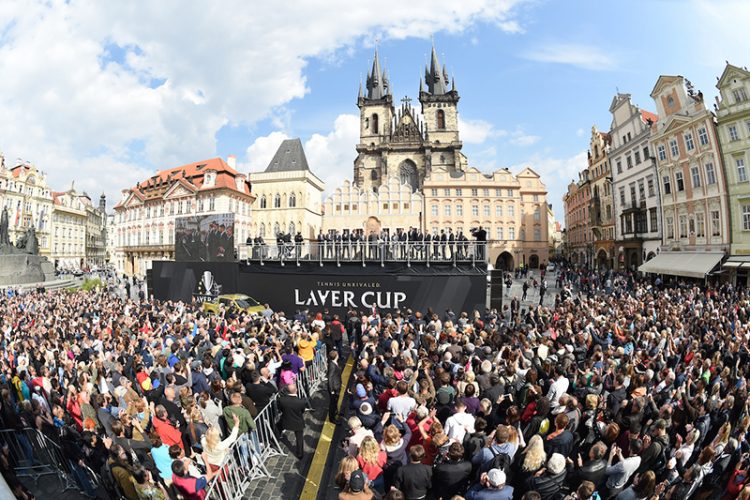
For the first iteration, the players lined up on a narrow cobblestone walkway outside a hotel along the Vltava River. The site was tricky due to the tight confines, but when the players started walking toward him, Brunskill remembers thinking: “Oh my God, I have every good player in men’s tennis here. The enormity struck me. I can’t mess this up.” To this day, Prague is Brunskill’s third favorite photo simply because it was the first.
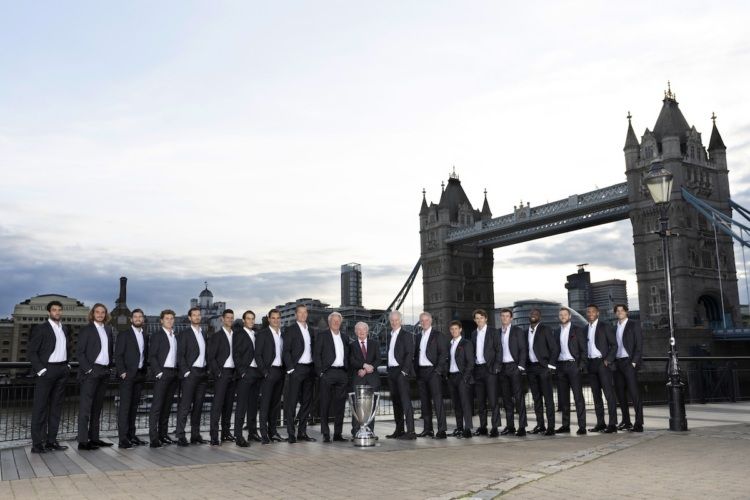
Players arrived via boat to avoid traffic at a private location with the bridge in the background. “There was a real buzz on Tower Bridge,” says Wright. “It was as close as you can get to the perfect shoot.” But it wasn’t as easy for Brunskill, with Rafael Nadal arriving the following day due to the birth of his child. Brunskill shot Nadal the following day, and he was photoshopped into the original, but there was extra work needed to retouch the suits so the colors matched exactly.
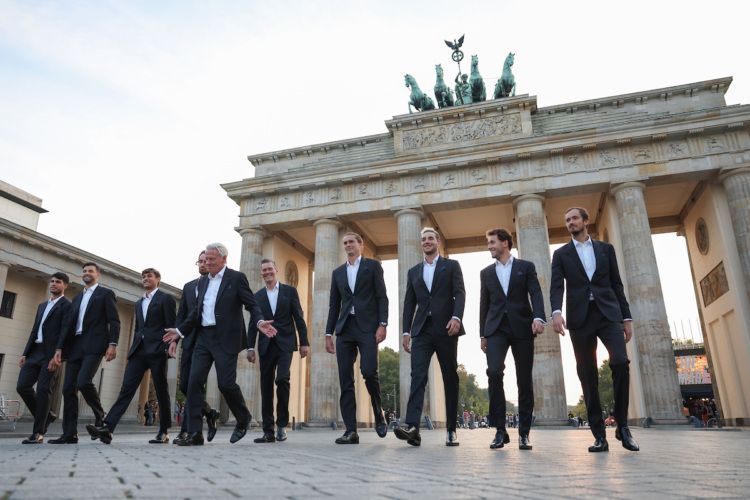
Such a well-known landmark in Berlin offered an obvious location. Plus, it was close to the player hotel. The big challenge was the site serving as such a popular tourist attraction. Laver Cup worked with the city and police to secure the necessary permits, but there was no way to clear the area. Earlier that day, the location was filled with protestors, street artists, and tourists. Wright says the public was respectful and cleared out for five minutes to allow the picture. “Everything fell into place in the end, but not without a few grey hairs along the way,” Wright says. The sun was also perfect, as it dropped below the gate. “Pop, pop, pop, I fired it off,” Brunskill says. “For me, that was the best one. That was mega. I remember Roger [Federer] saying, ‘I never thought you’d get that shot.’ It was brilliant.”
When Brunskill scouted the Golden Gate Bridge, the wind was whipping. He was worried about ties and hair flying about. The next night the bridge was shrouded in fog. The night before the picture, the bridge was clear, so Brunskill shot it in the evening sun, just as a backup, thinking worst-case scenario he could use the Tuesday photography of the and overlay the Wednesday picture of the players if the bridge fogged in. It would be a lot of work, but it could happen. Then on the day of the shoot, with a plan B location in place, the bridge was completely fogged in. “I said, ‘let’s go for it,’” he says. “It was brilliant. The sun was out, and it was lovely late-evening light, just really beautiful.”
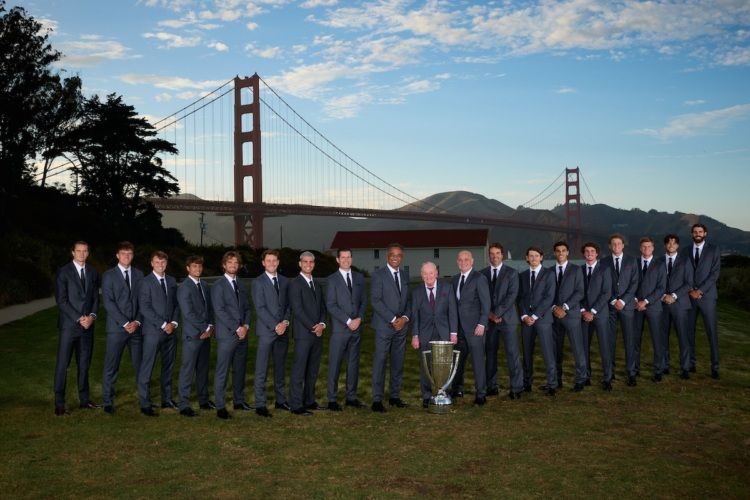
The iconic photo isn’t as easy as having players stand in a line. Brunskill positions them to ensure the hand placements are the same, the suits are sorted, the angles are accurate, and they are all looking at the camera. Then there’s the order. He typically forms a V with the players to reduce the width of the space needed and lines them up by height.
It takes cooperation from everyone involved. Brunskill recalls a past photo in which a Team World player was hamming it up, slowing the process. The photographer told him he was holding up Federer, Nadal, and Novak Djokovic. That was enough to keep the crew in line, showing that sometimes a bit of directing is part of the process.
“There is a lot more that goes into this shoot than meets the eye,” Wright says. “We think it is great because it captures a moment in time that someday we will look back on and be super proud to remember exactly which edition it was.”
What makes the perfect shot? “Every eye opened. Sharp. Correctly exposed. Does the sky look good? Is it interesting? You don’t want it just white, but want texture and a bit of orange,” Brunskill says. “The easiest bit is clicking the shutter once it is all sorted. The difficult bit is getting it sorted.”