SEPT 25 - 27, 2026 | LONDON

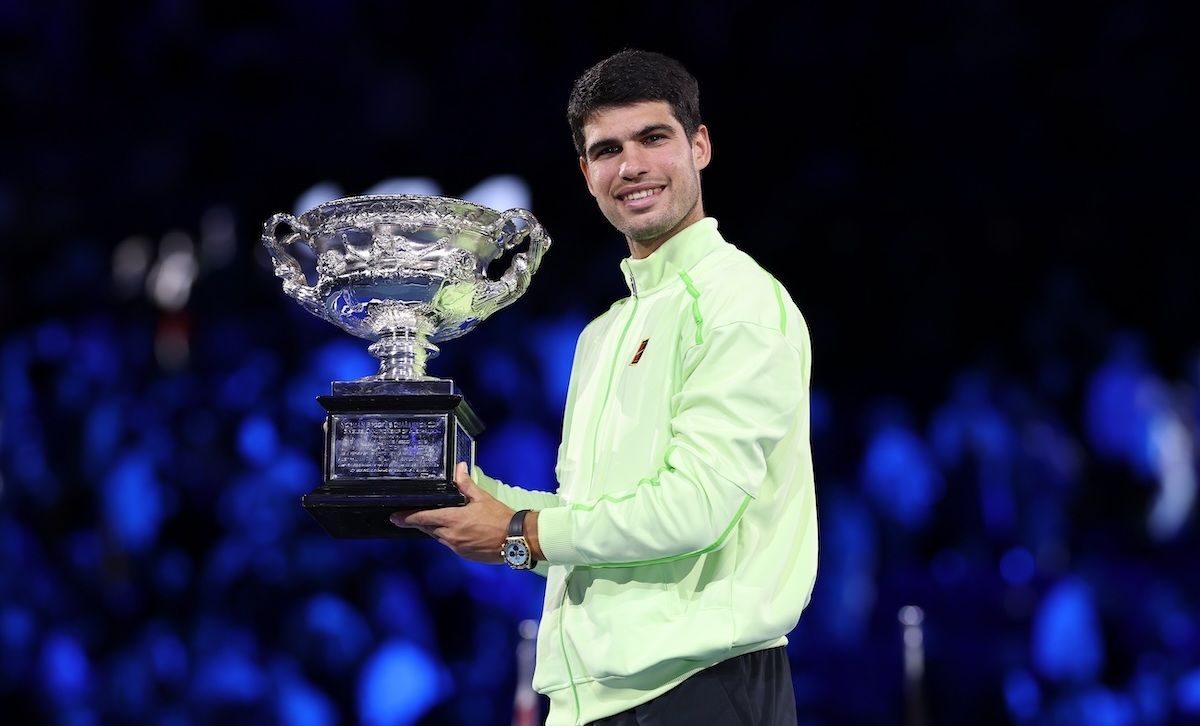
Carlos Alcaraz arrived at Melbourne Park with one box to tick. Two weeks later, he left Rod Laver Arena holding the Australian Open’s Norman Brookes Challenge Cup and a place in history as the youngest man ever to complete a Career Grand Slam.
At 22, Alcaraz won the first major of the season in front of his childhood idol, Rafael Nadal, who watched from a front-row seat inside the arena that bears Rod Laver’s name. Nadal had once done the same himself, winning his first Australian Open title in 2009 by defeating Roger Federer.
Federer’s own Melbourne breakthrough came earlier, in 2004, against Marat Safin. Alcaraz, who will represent Team Europe at Laver Cup London 2026, now joins them not just as a champion in Melbourne, but as a player whose career trajectory mirrors the very greats he grew up admiring.
His 2-6, 6-2, 6-3, 7-5 victory over Novak Djokovic on Sunday ended two remarkable streaks at once. Djokovic had never lost an Australian Open final, standing 10–0 in Melbourne deciders, while Alcaraz had never progressed beyond the quarterfinals at the tournament.
Intergenerational clash
Their contest also set a new benchmark in the tournament’s Open Era history. The 15 years and 348 days separating them marked the biggest age gap ever in a men’s singles final. Alcaraz was just four years old when Djokovic won his first Australian Open title in 2008. Yet on Sunday, the difference in lived experience dissolved into a match played on equal terms.
“Bravo Carlos, little titan, young wizard of Oz. A worthy champion, a huge talent, wonderful person, history-maker,” Djokovic posted on social media after the final.
Djokovic, who had turned back two-time defending champion Jannik Sinner in the semifinals, was contesting his first major final in 18 months and remains, even as he approaches his 39th birthday in May, firmly at the peak of the sport.
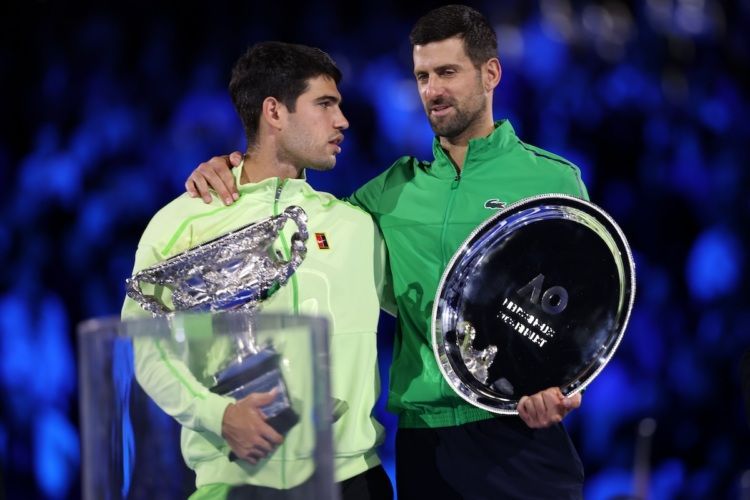
“The results are a testament to his already stellar career. I can’t think of any other superlatives about him,” Djokovic said of the No.1-ranked Alcaraz, after wrapping an arm around the Spaniard at the trophy presentation.
“He deserves every bit of the praise that he gets from his peers, but also the whole tennis community.
“He’s a very nice young man. Good values, nice family. Of course, already a legendary tennis player that already made a huge mark in the history books of tennis, I mean, with only 22 years of age.”
Alcaraz, for his part, spoke about Djokovic more as a north star, a reference point for the standard he is chasing.
“Every time that I’m able to feel that aura from him on the other side of the net, for me it’s a privilege,” he said. “It’s an honor, and it is like a master class for me to try to learn as much as I can. I have huge respect to him as an athlete, as a person.”
One for the record books
According to ATP Tour statisticians, Federer, Nadal and Alcaraz all won their first Australian Open title at the age of 22, on their fifth appearance at Melbourne Park, and in their first final Down Under – all on February 1. Alcaraz’s triumph also took his major tally to seven, well on the way to climbing the heights set by Federer (20 majors), Nadal (22), and Djokovic (24).
“Completing a Career Grand Slam was something that was on my mind,” Alcaraz admitted after his breakthrough title-win in Melbourne. Winning all four majors in one year – a calendar-year Grand Slam last achieved by Rod Laver in 1969 – was “going to be a big challenge,” he said.
“Those are big words, to be honest … right now, next one is French Open. I have great memories in that tournament. I feel really special every time that I go there
“I don’t want to put myself in a really pressure position to have to do it [the Grand Slam],” Alcaraz said, “but you know, it’s going to be great.”
Testing times
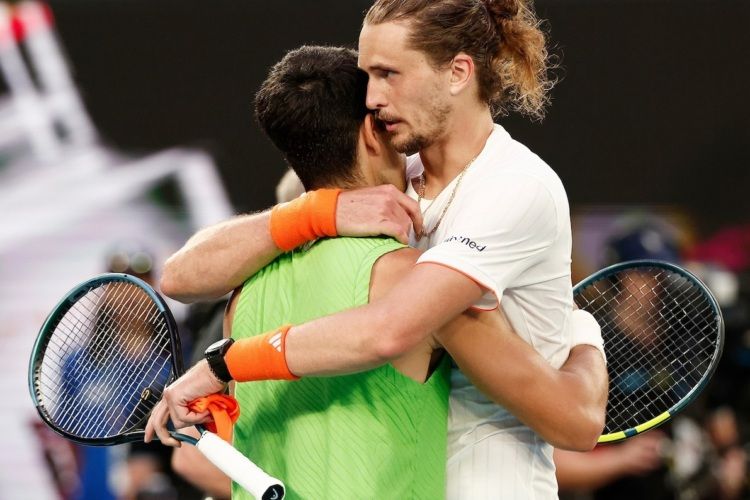
The road to the title was as demanding as the final itself. Alexander Zverev, the 2025 Australian Open finalist, and the man with the most appearances and points in Laver Cup history, pushed Alcaraz to the brink in a semifinal lasting five hours and 27 minutes, a match widely lauded as one of the greatest ever played in Melbourne.
No one came closer to toppling the eventual champion than his Berlin and San Francisco Laver Cup teammate. The scoreline – 6-4, 7-6, 6-7, 7-5 – told only part of the story.
“If I continue training the way I train, if I continue working on the things that I’ve been working in the offseason, I do believe it’s going to be a good year for me,” Zverev said.
Alex de Minaur, competing in his sixth major quarterfinal, also tested Alcaraz, buoyed by partisan home support. He came close to taking the opening set but could not wear down the Spaniard, even after producing some of his best ball striking against Frances Tiafoe and Alexander Bublik earlier in the tournament.
Elsewhere in the draw, Zverev accounted for Francisco Cerúndolo, Ben Shelton eliminated Casper Ruud, and Alcaraz dismissed Tommy Paul in straight sets, noting afterward that maintaining focus throughout the match had been a priority. Taylor Fritz, who will represent Team World at the ninth edition of the Laver Cup, to be held at The O2 in London from September 25–27 2026, also reached the round of 16.
At the conclusion of the season’s first major, Alcaraz faced a post-title dilemma more personal than professional: deciding where to place a kangaroo tattoo to commemorate his Australian triumph.
“What I’ve learned, you know, this year is about appreciate and enjoy every single second of the moment you’re living,” he beamed. “Not only lifting the trophies, but playing tournaments, playing tennis, getting victories, getting losses. Whatever it is, just enjoy and appreciate the life you’re living.”
Djokovic offered the final word on a champion he knows will shape the next era.
“He definitely is one of the best players I’ve ever faced in my career,” he said.
“He’s constantly looking to innovate himself and his game, which is exactly the kind of mentality that needs to be nurtured for a champion.”